For those whose historical knowledge is largely Hollywood-derived, you may be surprised to learn that there was a reasonably complex system of etiquette when dining during mediaeval times. Most people know that it was unthinkable to eat one's trencher (the wooden disc of bread which served as a plate). However, forks hadn't been invented, so one ate with the fingers of one's left hand, wiping them on a napkin placed on one's right shoulder. A prosperous household would provide spoons, but free men would have to bring their knife with them. Naturally, slaves would not be permitted to own a knife.
I am not his godmother. I don't know why not.
Food was not served in "courses" as we have now, but brought to the table in "removes" where sweet and savoury were mixed. A "two remove" meal, where the table was filled, the remainder removed, the table filled and removed and filled again, would equate to three table-loads of food. The more exotic and expensive dishes would be served in later removes, because the least-important people would be sent back to work after the first remove or two. Between removes, a "soteltie" - an elaborate pastry construct or something - would be brought out to demonstrate the skill of the chef. Butter was not usually employed in cooking, apart for dishes for the elderly and infirm. Saffron went in everything. And of course, a post-Lent feast should contain meat, and lots of it. With lard. And spiced wine.
Since it was Easter, we sat down for a special pre-remove dish of "Calfe sodden and blessyd" (boiled and blessed veal) and "Soden egges with grene sauce" (boiled
eggs in parsley, garlic, spice and vinegar sauce).
Note the blessing on the left-hand side of the dish
Herb sauce hand-pounded by me
We then proceeded to fill the table with the first remove:
To give a break-down of the dishes:
Furmenty: wheat boiled in milk and stock (not quite cooked in this snap - the finished shot was a bit blurred)
Venysoun, to go with the Furmenty
Pevorat: breadcrumbs fried in lard, mixed with vinegar. To go with the venison.
Pigges in sawge (boiled pig with sage sauce. Also roast pig).
For to boile partritch (What it says on the label)
Pesoun of almayne (literally "German peas" - split peas cooked in spices and almond milk)
Aquapatys (garlic boiled in oil, with spices)
Appulmoy (apple, almond and saffron)
I'm a fan of frumenty and split peas anyway, but the surprise hit on this remove was the pevorat. In Prague, we'd found the Czech equivalent of restaurant breadsticks to be sliced brown bread and a pot of salty lard with bacon bits. The pevorat had a similar flavour (lacking in bacon, but I'm tempted to add it should I ever make it myself). It was meant to be used as a sauce with the venison, but it went very well spread on bread, or as a vegetable. Lard is a vegetable, isn't it?
The leftovers were cleared, and the chef's first soteltie was brought in:
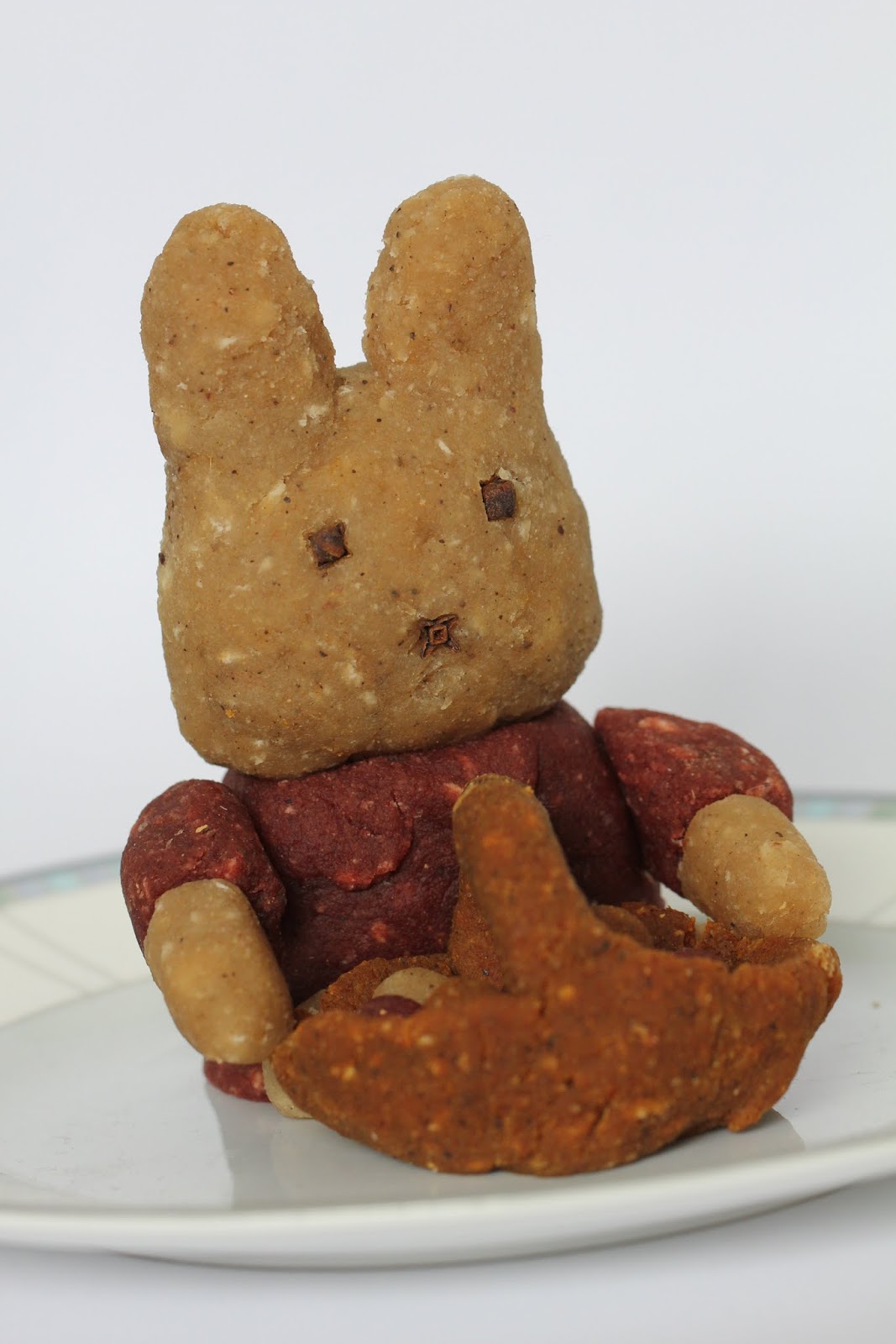
A gingerbread (i.e. breadcrumbs, honey and ginger) Miffy. Coloured with saffron and sandalwood.
Then it was time for the second tableload of food:
This consisted of the following:
Iussel (eggs scrambled in stock)
Mameny: chicken, almond milk, stock and rice flour. And saffron.
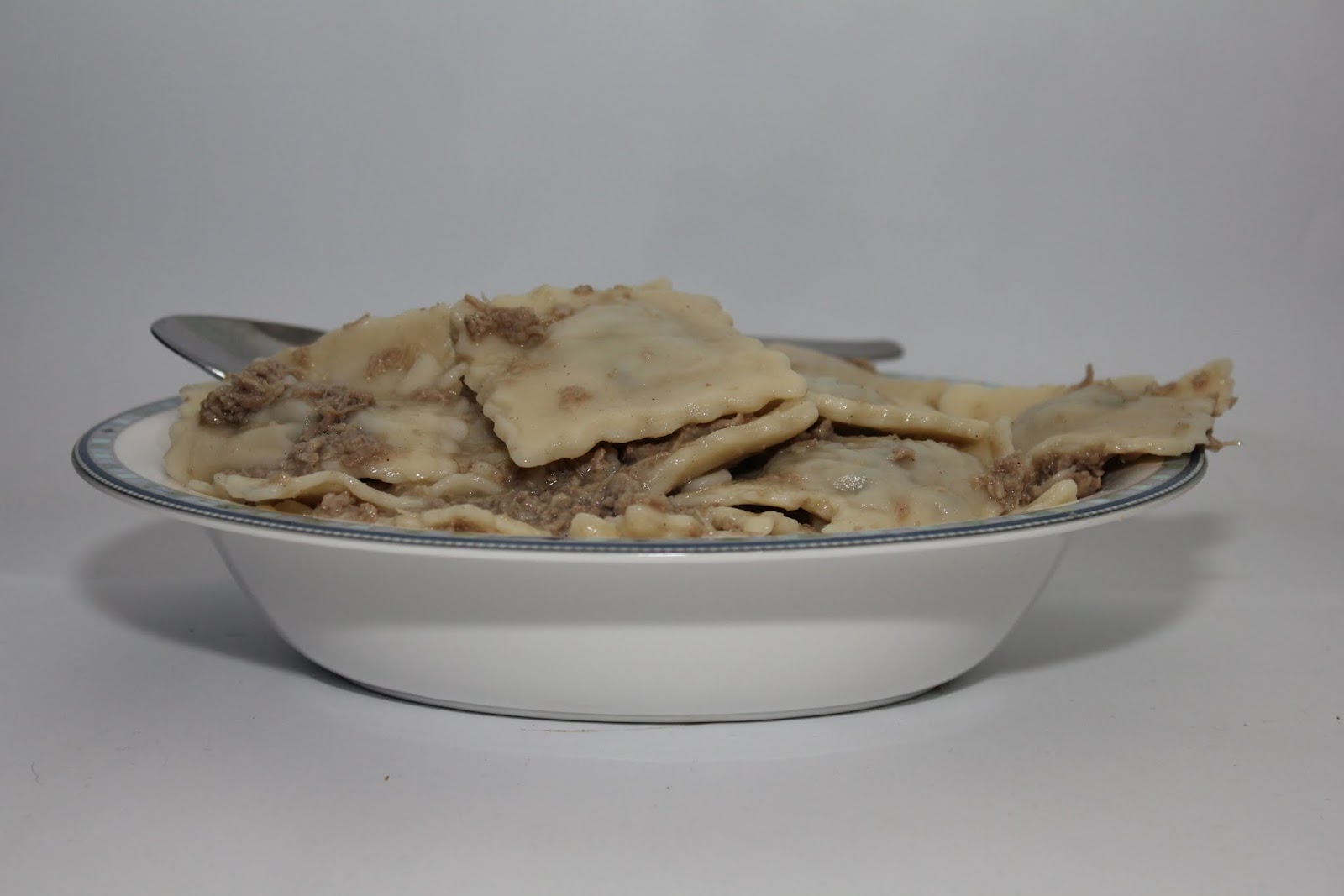
Tartlettes. Seriously, they had ravioli then. With a spiced pork-and-raisin filling.
Connynges in clere broth (aka "rabbit stoo")
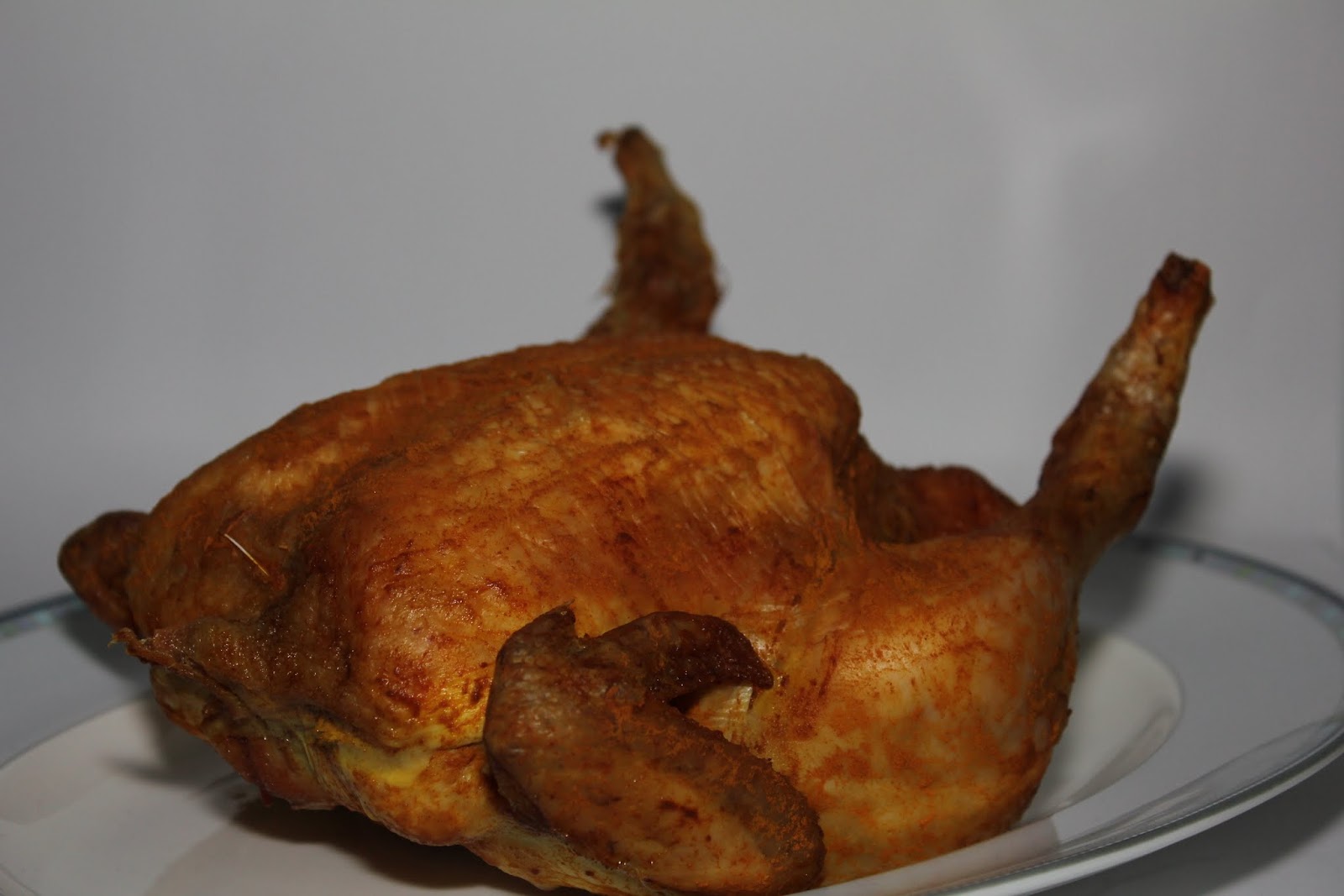
Capon endorre (golden roast chicken - the "gold" is saffron).
Vyuande cypre (pork and
chicken, minced with dates and spices)
Chyches (chickpeas in olive oil, garlic and spices)
Spynoches (spinach fried in lard with pepper)
The Mameny was a little bland, and the Vyuande cypre was insanely sweet, but the scrambled eggs were identified as an optimal hangover breakfast, and the ravioli was very modern (but if a recipe says "take minced pork and wrap it in thin leaves of dough and boil it", how else are you to interpret it?)
Once this was removed, it was time for the chef's next soteltie:
That's right, a sheep-shaped pie containing four-and-twenty fluffychicks. And sweeties.
We had a brief respite from eating whilst we played the traditional mediaeval game of "Who can eat a Haribo Tangfastic and then drink a cup of sweet mead?". The answer was "most people" - possibly the saffron was providing a protective coating to our tongues.
After whetting our appetites, it was time to move on to the serious eating:
Custard tart. OK, so it's called "Dariols", but the recipe for custard tart hasn't changed since 1390. It has saffron.
Crustardes (chicken, pigeon, pheasant and dried fruit pie)
Hasteletes (fig, dates, raisin and almond threaded on a skewer, in a saffron
batter, roasted)
Bursews: Pork-and-egg spiced meatballs. Battered. I can't remember if they contained saffron, but the odds are in favour that they did.
Rost of smal bryddes (quail, pigeon, and pousin, roasted)
Fryturs (battered apple fritters)
Having eaten this, and squabbled over the remaining hastelettes (oh, but they were good!), we retired to an adjacent room, admired the chef's next soteltie whilst eating confits and wafers and drinking pyment and hypocras, and felt a bit over-larded.
Sotel. Very Sotel.
Many thanks to Mrs S for the copy of her notes so I didn't have to work out how to spell the foodstuffs myself, and for all her sacrifices in the kitchen.
So. My friend Mrs S is (a) a very good cook, and (b) an (grammer!) professional historian. So, given an excuse to cook something esoteric and authentic, she will. And what better excuse for that than the fact that the weekend just passed would have been Easter, were it not for that wretched Papal Bull issued by Pope Gregory XIII. And thus it was declared that there would be a Mediaeval Easter Feast!
There were many preparations. Although Fancy Dress was not compulsory (indeed, the last Mediaeval Feast which was hosted by the S's, Mr P turned up wearing a long scarf, a wide-brimmed hat, and proffering jelly babies), I decided to make an effort. When I was informed that there was a garment called the Gates of Hell surcote (so named because of its wide armholes, revealing the shape of the woman's dress underneath her other dress - shameless!), it was clear what I had to make!
Oh the sinful nature of this dress! Beneath it, save for my other dress, shirt, underwear, tights, etc, I was almost nekkid!
I didn't think it came out too badly, despite some damn fool casting himself into the Thames whilst I was trying to sew with the TV on, and distracting me enough to do a wonky seam.
Costumes aside, there were a lot of other preparations to be made. Those familiar with mediaeval dining arrangements will appreciate that the tableware had to be baked:
Trenchers
Mrs S spent many days (weeks!) beforehand preparing things. The aim was the replication of a royal feast recorded in 1390, and the recipes required translation, research and experimentation (they pre-dated the invention of measuring ingredients, or spelling). We arrived to help on the Friday (orthodox Good Friday) evening and Saturday morning. I foolishly looked at the recipes for the herb sauces, and pointed out that crushing plant material with a pestle-and-mortar releases very different flavours to those produced by shopping herbs in a food processor, and was promptly handed a pestle-and-mortar and half a herb garden.
With effort and time, this...
...became this!
Parsley and mint was manageable, but sage was somewhat tough!
In the end, we cheated and employed a Mechanical Minion (aka "food processor") on the sage. In the meantime, other preparations continued apace. Pork and poultry
were smoked on an applewood fire:
Almonds were threaded onto skewers by means of a traditional Mediaeval Method which involved an electric drill:
Food was set in readiness, and it was time to prepare for the Feast!
When one doesn't often eat breakfast, making marmalade, whilst enjoyable, leads to a "now what do I do with all this" problem.
On account of not going to yoga yesterday (having come off my bike, I thought it a little anti-social to go and use the studio's mats whilst my shins and ankle were still oozing and weeping), I decided to make marmalade cakes.
The following is an amalgamation of two or three Nigella recipes, a hefty dollop of Bryony's Mum's recipe, all served up with a few bits of my own devising:
Preheat the oven to about 175C. Sift the flour, bicarb and baking powder, and mix together the dry ingredients. Melt the butter, and stir it into the yoghurt and egg. Gently combine the wet and dry ingredients, taking care not to over-stir.
Put teaspoons of the mixture into silicone mini-muffin cases so that the cases are just under half-full, and make a little "well" in the centre of each. Put small dollops of marmalade into each well. Then put another teaspoon of muffin mixture on top, making sure to seal in all the marmalade (otherwise it will boil out as a horrible sticky mess).
Put into the preheated oven and bake for about 15 minutes until golden.
Once the muffins have been taken out of the oven, melt the other butter in a pan with the spices. Carefully remove the warm muffins from the cases, dip them in the melted spiced butter, dunk in the sugar, and nom immediately.
Variations
I also made some full-size muffins like this, but rather than faffing around with melting butter, I sprinkled the spices and some demerara sugar on top before putting them in the oven. Equally, I think it would be perfectly sensible to mix the spices in the flour whilst making the muffins, but I only thought of that after putting the muffins in the oven.