Thank you for your letter expressing your
support for same sex marriage. I am afraid we will have to agree to
disagree.
Along with 174 other MPs I voted
against the Second Reading of the Marriage (Same Sex Couples) Bill. I had a huge
postbag on the issue and the vast majority of constituents who wrote to me were
against the Bill.
As the vote showed, I am in a
minority and I have no doubt that it will become
law.
Yours
Sincerely,
Should I write back to him and explain the
problems with his data selection method? The contents of a postbag do not
necessarily represent the views of a constituency. By limiting communications to
a postbag, you've excluded those who have neither the ability or inclination to
write. I would hazard that his postbag contains opinions of a greater proportion
of elderly (more accustomed to letter-writing than the electronic generation),*
retired (have enough free time to spend on this), affluent (can afford to spend
time engaging with their MP), literate (probably not dyslexic or
poorly-educated) people than the current population. And that's before even
considering whether people who object to a change are more inclined to be vocal
about it than those who don't. I don't know if any research has been done on
this in general, but the impression I got in this case was lots of small lobby
groups who opposed the change in the law encouraging supporters to be very
vocal, whereas those who supported the change didn't feel the need to do or say
anything because they assumed that the change would go ahead regardless.
*When I told a cow-orker that I had written to my MP, he laughed and said "You wrote to an MP? How old are you? Seventy?!?"
I found Delhi a weird place. Not as bad as the friend who said "If you find anywhere nice in Delhi, then you're not in Delhi any more" had led me to expect, but odd. It felt like two cities inhabiting the same point in the space-time continuum, but slightly out of phase with each other. One city is one of the wealthiest in the world, full of consumerism, high property prices, obligatory car ownership, middle-class aspirations, brand names, western clothing and shopping mall culture; the other city is a city of beggars, roadside shanties and people defecating in the street. And of course in the middle of all this there are ancient monuments and buildings such as can be found in any large city with sufficient history.
Government employees on the way to work. Srsly: the monkey is a "pest controller".
We were treated to a whistle-stop tour of
the city, and saw the points that all the tourists have to see, and had a
bicycle rickshaw ride, and all that. I had cunningly arranged my
wardrobe such that I would be respectable and decent for the Jama
Mosque, but I was still required to don a floral hospital gown over my
clothing - despite the fact that my clothing was longer and hanging out
of the gown. Our guide Manjit (a former Surrey cricketer) apologised and
explained that this was a recent requirement - ever since a group of
Australians decided to strip off for a photoshoot in the mosque, all
women not wearing traditional dress are made to wear the Gown of Shame.
Thanks Oz.
Qutub Minar
I quite liked Humayun's Tomb - partly because it is an impressive piece of architecture, but mostly because there was a family of kites I could watch goofing around together as they tried to build a nest.
“I’m fed up with work at the
moment, so have booked some time off. What last-minute bargains can
we get to somewhere sunny in a fortnight’s time?”
“Well, there’s some fantastic deals
to be had in Mexico at the moment – oh, but Google says it’s
hurricane season down there in October. Otherwise some companies are
doing good bargains on certain areas of Thailand.”
“Which areas”
“Um, the areas which are either going
to be experiencing the rainy season, or those to which the UK
government has advised against all non-essential travel due to people
with bombs, or both.”
“How about this 30% off a five-star
hotel in Sri Lanka?”
“Would that be on the coast that
Lonely Planet says is highly likely to experience heavy rainfall
during October?”
“Er…yeah.”
.
.
.
.
“So what we’re saying is that for
the same price as a bargain five-star hotel in a hurricane-hit resort
in Mexico, we could just pay full-price to get a tailor made tour of
India where it’s going to be sunny and warm?”
“Pretty much.”
“No contest then. I wonder if we can
get visas and vaccinations sorted out in a fortnight?”
And so it began…
Much to my surprise (having encountered
the navigational nightmare that is the Indian Visa Information UK
website) the staff in the Indian Visa Centre in London are
wonderfully helpful and friendly, and issued us with visas in about
three days. And it turned out that we only needed one booster from
the NHS, having been stuck full of every inoculation under the sun
before we went to Madagascar last year. Admittedly, there was a
little mix-up at the clinic as the nurse thought I had come for my
smear test and wondered why I was rolling up my sleeves, and I was
puzzled when she asked me to remove my underwear, but we managed to
clarify matters before things got too out-of-hand.
I used to be, but I’m not any more.
You see, it’s very hard to be a female scientist. It starts during
education – I was educated in the sheltered environment of an
all-girls’ school and believed the propaganda we were told – that
females were just as good intellectually as males, if not better, and
we were entitled to choose whatever career we wanted – even in
traditionally-male areas. We were told about “sexism” but because
we had never encountered it, we thought it was a thing of the past.
I then went to university, and had to
rapidly rethink my worldview. Chemistry tutorials with the
Ambisinistrous Professor (he wrote equally illegibly with both hands)
were a constant source of frustration as the professor would address
all his comments to the males in the group, and change the hand he
wrote with so as to screen his writing from the women. At first I
thought it was a coincidence, but then I experimented with moving my
seat (sometimes even mid-tutorial) and found that he would move as
well, to continue to block my view.1
Fine. He was obviously one of these “sexists” I had heard about,
but he was obviously a relic from an older era, and his kind were on
the verge of extinction.
Wrong. In a recent study,2
researchers sent CVs to employers, asking if the applicant would be
considered for employment and mentoring. The CVs were identical apart
from the genders. Far more of the female CVs were rejected than the
male CVs, but the employers would not admit (probably even to
themselves) that they had rejected the female for her gender; no,
they would explain that the female was a less-good candidate, see all
her flaws here! So not only are women being denied opportunities to
advance, but they are also being told that they are more crap than
their male equivalents! In order to get anywhere in science, a woman
would have to be better than the men, and not believe people
who tell her she is crap.
Another major, major hurdle for
women trying to make a career out of science is the whole “uterus”
thing. I’ve ranted about this before so I
won’t go into it in depth, but the upshot is that very few
employers are willing to hire someone on a three-year research
contract if there’s a chance that they will spend a year of that on
maternity leave. Personally, I think equal parental-leave rights
would be a great solution, where either parent can take the time off
to look after the baby. It might also help break the self-fulfilling
cycle of “women are lower paid because they take maternity leave
and aren’t as useful to a company” and “women are usually the
ones who take maternity leave because they are lower paid than their
partners”.
And now the BBC have an article on the
fact that more women are needed in technology – together with a
lovely mockery of the “Pink it, shrink it” approach taken by some
(male) designers when trying to make a female-oriented product (is
anyone else remembering the “Bic for her” fun?). The LittleMiss Geek
certainly looks like a better campaign than the “Science: It’s a
girl thing” one, where people attempted to explain that girls can
do science too, because they can wear pink
lab coats and investigate the chemistry of lipstick…
Anyway, I am not a scientist. I used to
be, but I’m not any more. I was a good scientist (I think), but not
an outstandingly brilliant one. I found it incredibly hard to
get a job. I don’t know whether this was because I just wasn’t
good enough, or because the entire system was inherently stacked
against me. All I know is that it would have been nice if the playing
field had been level enough for me to find out.
1
Some of you may ask why the women didn’t work together, and sit in
a way that meant he couldn’t block both of us. We tried this, and
found that he would, if he had to choose, obstruct the most
“feminine” woman – so my fellow female tutoree in combat
trousers and cropped hair would fare far better than me with long
hair and a skirt.
I rather like the Olympic and Paralympic mascots. The Paralympic Mascot in particular is very cute, and clearly a cyclist with his padded gusset and aerodynamic vented head. Admittedly, I also think that the creature in Alien would have made a lovely pet if only someone had tapped it on the nose and said "no" firmly after it ate Brett and Dallas, and I have cuddly crocheted Cthulhus, so what do I know?
Anyway, when Tim discovered that the toy shop had all the Olympic and Paralympic paraphernalia heavily discounted, I was rather overjoyed to receive a giant Mandelbrot.*
I then decided that I needed more Mandelbrots, so that I could have a set of them (this makes me giggle far too much).
I have since realised that I missed a bad punning opportunity, and need to go shopping for more Olympic mascots, on order that I may have Much Wenlock, but in the meantime the Mandelbrot Set are fitting in well with the rest of the cuddly toy collection.
*OK, according to their labels, they're meant to be called Wenlock and Mandeville, but they'll always be Mandelbrot and Wensleydale to me.
Before I was born, my parents
were hugely into the whole Folk Rock scene. Y'know, Lindesfarne, The
Dubliners, The Searchers, The Seekers, Fairport Convention, and Steeleye
Span. Especially Steeleye Span. Not only was my childhood easy-listening
largely on the theme of Murder, Cuckoos (yeah, I know what that means now)
and Elves, but I even had the Folk Rock Nursery Songs by Tim Hart (of
Steeleye Span) And Friends. Whilst other kids were learning about Humpty
Dumpty and the hazards of wall-climbing without adequate safety gear, I was
singing along to the Three Jolly Rogues Of Lynn:
In good King
Arthur's day When we served under the King Lived a miller and a
weaver and a little tailor Three jolly rogues of Lynn.
Now the
miller he stole corn And the weaver he stole yarn And the little
tailor he stole broadcloth For to keep those three rogues warm
Now the miller was drowned in his dam And the weaver was hanged in his
yarn And the devil put his claw on the little tailor With the
broadcloth under his arm
Now the miller still drowns in his
dam And the weaver still hangs in his yarn And the little tailor
he skips through hell With the broadcloth under his arm
Of
course, murderous rhymes for kiddies weren't all. This was the 1980s, when
things like The Hunting Of The Snark were being made into musical concept
albums. One of my favourite LPs as a child was The King of Elfland's Daughter
- based on the rather cool book of the same name,
written by Lord Dunsany. The book has a lovely whimsical sense of humour
running throughout - there's one point where a troll (not that one)
tries to convince a child to run away to Elfland. In the end the child
refuses to go because "Mother made a jam roll this morning."
Anyway, the musical version was the brain-child of Steeleye Span members Bob
Johnson and Peter Knight, and featured a number of jaunty songs about
killing, kidnap and elves. It also featured Christopher Lee as the King of
Elfland (and the narrator), which I think was an early try-out for his role
as Saruman. In the finest of Folk-rock concept album traditions it had a
couple of songs one could hum along with, weird sound effects, solemn
declaiming of lines, and some mediocre filler pieces.
I merely
mention all this, because one of the wimpiest, most forgettable songs from
TKoED was titled "Just another day of searching", and it would upset me to
think that people might not get the terribly clever, delightfully obscure
reference in the title of this blog post.
Anyway, according to the
stats, the search-terms which most commonly bring people to this website
(excluding the name of the blog, and its derivatives) are:
4: "All Things
Pyrate" 3: "Defenestration Images" 2: "Duck soteltie" (which is
interesting, because there is no duck soteltie on these pages) ...and in
first place, "Curse of
Cain"
If one is a regular or frequent cyclist, then one develops a keen awareness of the state of one's nether regions. F'rinstance, after a lengthy day on the bike in the rain, with no mudguards, and the chamois padding in one's shorts slowly becoming saturated with gritty water, the realisation dawns that the greatest thing in the world is not Universal Suffrage, or equality, or the invention of the electron microscope. Nope, a far superior thing is this: a pair of clean, dry pants.
And, trying to avoid going in to too much detail regarding saddle-sores and chafing, loose-fitting pants of a French knicker variety can be rather comfortable post-ride - not to mention the convenient lack of VPL that they provide when worn with a skirt. So it came to pass recently that I found myself in need of more pants (mostly due to the cats installing a mouse in the bedroom, which set up home in my underwear drawer and chewed up a number of garments to construct a nest), and went shopping.
I'm British, so naturally my first port of call for underwear was M&S. Much to my surprise, they didn't have any French knickers in the Kingston branch, so I looked online. Even more of a surprise was to discover that they only sell one style of French knickers, and they are a limited edition which are totally out-of-stock. Even so, that's a higher big-pants quotient than any other high-street shop.
Having failed in Real Life, I took to the internet. Surely, I thought, I will be able to find some suitable undercrackers there! Well, it being the internet, rule thirty-four applied. Once I had eliminated all the crotchless peep-hole feather-trimmed cheap nylon varieties of French knickers (and confirmed that no, I did not mean "French Maid's Outfit"), there really wasn't anything there. In fact, the only knickers available were all terribly skimpy and high-cut. This got me thinking. Without going off on a hairy-legged-feminist rant, we live in a society which deems pubic hair hanging out of the side of a bikini or underwear to be disgusting - and yet there are no kickers for sale which fully conceal the pubic-hair region. Are the manufacturers of knickers* in league with the makers of hair-removal products? The people have a right to know! <waves conspiracy theory flag furtively>
Anyway, back to my personal Persnonals hunt: eventually I found some French knickers online. They appear to no longer count as "underwear" and have been reclassified as "nightwear". Irritatingly, this means that they are not available in specific sizes, but are only sold in "small", "medium" or "large" sizes, with a thick elasticated waistband which is not so invisible under dresses as some of my older pairs I am trying to replace. And also, they seem to cost about £80 per pair for silk ones, which is a tad steep.
So if anyone knows where I can buy some non-porno non-pyjama French knickers I'd appreciate being told. Ta. :)
"Oh, I saw you and your husband on your tandem last night."
"Oh yes?" (in a vague non-committal manner. People seem to like to tell me when they've seen me on the tandem. I'm not sure why, or what response is expected, but it seems to make them happy.)
"Yes, I was just behind you at the lights. Just one thing," (mock scolding) "Where was your helmet?!"
"With my mountain bike, for the next time I need it."
"Well, it meant I took extra care not to knock you off as I went past because of it!"
And that's why I don't wear a helmet on the road, folks!
Whilst England has been experiencing yet more Floods, I took the Eurostar and spent the weekend in the moderate dryness of Paris.
I like travelling by train - there's room to move around, I can take a picnic with a decent bottle of beer (or wine), I don't get airsick, I only need to be there thirty minutes prior to departure, and the security check-in procedures aren't as offensively intrusive as they are at airports. Nonetheless, I was mildly annoyed by the Jobsworth who insisted that I remove my (thin cotton tailored) coat to reveal my (thick cotton tailored) dress to go through the metal detector. I thought it might be funny to turn up at the security desk wearing only a coat with nothing underneath and see how that would be received, and contemplated tweeting such, but then I remembered #TwitterJokeTrial, decided that threatening to get nekkid would probably class as "menace", so I didn't.
Anyway, one train and three beers later, we arrived in Paris for a sunny evening's wander along the Champs Elysees and a wonder as to how many English people each statue's namesake had killed, and how old the grandfatherly bouncer outside the World Famous Crazy Horse actually was.*
*We think mid-seventies. It rather put us off the idea of the nekkid girls, sorry, I mean art, inside.
For those who have seen Amelie or Moulin Rouge, I have to say that Montmartre is nothing like the films. The region around theSacré-Cœur is packed with tourists and hawkers trying to sell you special lucky majik pieces of string, and the area by the Moulin Rouge is a tarmacked dual carriageway vaguely reminiscent of Southend seafront, but with sex-shops rather than casinos.
However, it does have a rather lovely cemetery, if you happen to like that sort of thing, which I do. Crows posing goffickly, sun-bathing kittehs, and a plethora of statuary.
Note the contents of the flower trough...
But if the Doctor Who episode Blink scared you, I suggest that
you keep away.
I like yoga as a form of exercise, I
really do. I first got into it some years ago, when I was doing a lot
of cycling and not a lot else, and my body was becoming terribly
unbalanced as a result – huge chunky thighs, weedy arms, and very
little flexibility at all. I was lucky enough to be working with
someone at the time who was a qualified yoga teacher, and she
introduced me to Ashtanga yoga.
For those unfamiliar with yoga, just as
the term “cycling” can cover anything from “popping to the
shops on a bike” to “hooning downhill on a full-suss MTB” to
“riding a 600k audax”, there are many different forms of yoga.
Ashtanga is a very active aerobic form of fitness which exercises
almost all the muscle groups. None of this
sitting-around-contemplating-one’s-navel. Each posture should flow
into the next, via a vinyasa (a very elaborate push-up/plank/set of
bends move), and it’s a lovely workout. I’ve tried other forms of
yoga (Iyengar, Hatha), and not enjoyed them half as much as I do the
flowing sequence of Ashtanga.
What really does hack me off though, is
the fact that seems impossible to find somewhere that does the yoga
without the hippy bullpoo and complete lack of understanding as to how
the body works. I’ve been to classes where teachers insist on
starting with breathing “exercises” which involve sticking your
fingers up your nose and your thumbs in your ears and breathing in a
peculiar rhythm in order to “detoxify”. I’ve had teachers
belligerently insist that menstruating women mustn’t do
inverted poses (headstands, shoulder stands, full back-bends etc)
because it would do untold damage to one’s insides as the flow
reversed (fortunately my first yoga teacher took the more sensible
attitude of “What’s it going to do: come out of my ears?”1
and ignored this superstition). I’ve been told by
otherwise-sane-sounding people that a certain pose is good because it
“massages the liver and releases nutrients into the blood”. I’ve
been instructed to “breath deeply into the kidneys”.
My current studio is lighter than many on the bullpoo quotient, but nonetheless there's still an underlying trend. It’s so disturbing that so many
rational and reasonably-educated people believe all this and worse
that I’m tempted to leave a copy of Ben Goldacre’s Bad Science
lying around the studio I currently attending. But I won’t – this
stuff is close enough to a quasi-religious belief to some people that
I fear trying to persuade them to think rationally about what they’re
saying will upset them. And most of them are nice enough people that
I don’t want to do that. But the problem is that there’s a
self-perpetuating cycle of irrationality around the yoga industry.
Anywhere offering yoga classes will invariably also offer
aromatherapy, homeopathic nutritional supplements, chakra
realignment, and half-a-dozen other half-baked ideas which keeps yoga
firmly in the Hippy Woo camp, and makes it unattractive to scientists
and rational-minded people just looking for a form of exercise. Which
is a shame, because I think yoga is great.
1
Chuffy and Frood have helpfully suggested Mooncup ear-muffs and a
tampon up each nostril just to be on the safe side.
My paternal grandmother was notorious
for boiling vegetables for upwards of two hours, in water with a
pinch of bicarbonate of soda “to keep the colour in”. This would
produce vivid green broccoli which would disintegrate as soon as it
was looked at. Similarly, my maternal grandmother’s speciality
(you’ll notice my grandfathers didn’t cook at all – unless you
count the time one proudly informed us he’d managed to cope while
his wife was in hospital by opening a tin of rice pudding all by
himself and then eating the contents cold) was cabbage boiled for
many hours, tipped into a “calendar” (or, as the rest of the
world called it, a “colander”), compressed into a cake with a
saucer on top, and then served by the flabby yellowing slice.
With a heritage like that, it’s no
wonder that the culinary fare I grew up with wasn’t terribly
adventurous. Food as a child had practically nothing in the way of
spices (though to be fair, my father would be sitting mopping his
brow if there was too much pepper on his bolognaise), and I didn’t
encounter curry until I went to university.
If one says “I’m not really used to
curry”, almost immediately a chorus of voices will chime in telling
you that you must start with a mild korma, and “work up”.
It’s a bit like if you’re not a coffee drinker – people try and
wean you on to it by way of really milky sweetened mochas. It took me
nearly ten years to work out that I actually do like coffee –
but only if there’s no milk or sugar. As for curry – I’m no
great fan of tomatoes (it’s not that I actively dislike them, it’s
just that I don’t see the point, and would rather eat something
else if the opportunity is available), so lumps of meat boiled in a
tomato sauce with a bit of powdered coconut is never going to appeal
to me. However, tomato-free Thai curries were approved of and
devoured enthusiastically.
So I got through university with a
somewhat ambivalent attitude towards Indian curry, although my
capsaicin tolerance increased significantly due to other culinary
adventures. A few years after Tim and I married, we received a set of
recipe books: an Italian recipe book, a Thai recipe book, and an
Indian recipe book. I thanked the donor, began using the Italian and
Thai book, and put the Indian book on the bookshelf and forgot all
about it.
More years passed, and one rainy day I
opened the Indian recipe book and flicked through it. I was
astonished to learn that there’s a lot more to curry than simply
lumps of meat boiled in tomato sauce with chillies. I purchased some
ingredients. I did some culinary experimentation. I did more research
(for those interested in the history of curry, I recommend reading Curry: A Tale of Cooks and Conquerors- a book which explains how each new invader of India brought a new
ingredient and cookery style (thanks to Mrs S for the loan)). I
discovered that I really like curry, and I really really like
cooking it. The curries I like are primarily those originating from
the North of India where the tastes tend more towards the sharp, hot
and sour, so if I am cooking for friends (by habit I tend to cater
for forty, invite half-a-dozen friends, and then freeze all the
leftovers for microwaving on busy days. Yes, this is very sad, and I
will probably find myself alphabetising my shoes next.) then the menu
is distinctly skewed in my favour, with lots of sour lentils and not
a korma in sight.
If you admit that you don't drink coffee, then
everyone's advice is to "work up gradually". When I first tried to drink coffee,
I found myself being fed mugs of sickly sweet milky mochas which were utterly
revolting. It took me some years to work out that I do in fact like
coffee - just not with sugar and definitely not with milk. After all,
Marie Antoinette used to swear by milky coffee for her complexion, and just look
where it got her. Coffee must be black and strong and flavoursome in my
opinion.
It's the same with beer. "Oh, not a beer drinker, eh?
Try this really weak light ale with lots of hops and a floral flavour!" I
don't like
citrussy flowery beer. I like rich thick creamy beers with dark roasted malts
and a velvety chocolate taste on the tongue. I suspect a lot of non-beer
drinkers are the same, but don't realise it.
Credit should go to the Canterbury Beer Festival
who have had a "Pink Girlie Bar" in previous years, which contains lots of
porters and stouts for the non-standard beer drinker. I really can't be bothered
to complain about the potential sexism in this approach - the majority of Real
Ale drinkers are men; not many women will try Real Ale (especially with the pump badges some of them use!) unless encouraged; The "Pink Girlie Bar" does seem to have been
successful in encouraging a whole new demographic to try real ale; most of the
beers I want to try are located on the PGB each year; and finally, the PGB was
responsible for one of the best overheard conversations of the festival:
"Sharon, didja try that raspberry wheat beer?""Yeah 'Chelle, but I din't think it tasted much like
raspberry Bacardi Breezer at
all!" In fact, my only complaint with the PGB is that it
results in queues for the ladies' loos, which is normally unheard of at beer
festivals!
But I digress. Normally, I look forward to winter,
season of Stouts and mellow Porters. Sadly, this year there were very few dark
beers available in my local pubs, which was quite a disappointment. Fortunately,
it is now the month of May, and I can hope for a higher-than-average number of
Milds around. Milds aren't as flavourful as porters or stouts, but they do have the advantage
of being a much more sensible strength.
Last Sunday, we went to the Natural History Museum to
see Animal Inside Out. A museum is a great place to spend a rainy day, but you do
have to get there early to avoid the crowds. We got to the museum a couple of
minutes before it opened, and there was a huge queue along the pavement. Now,
What is it with Londoners and umbrellas? Do they all wake up in the morning, see
the rain, and think "I'm going to be wandering around a densely-populated city
all day, so what I really need is a device which increases my effective
diameter, gets stuck on lampposts when I try and squeeze past them, and pokes
people in the eye"? Have none of them heard of hats? Fortunately, after about
ten minutes of umbrella-dodging we got close enough to find a person who told us
that if we had tickets we could by-pass the queue and go straight in, so we did,
and we had a lovely empty museum for about fifteen minutes.
Not-empty museum
The exhibit itself was
somewhat light on the SCIENCE, but quite fun to look at and I did learn some new things, like the fact that shark hearts
only have two chambers (as opposed to the four chambers in avian and mammalian
hearts), but mostly I amused myself by checking to see if each animal was a boy
or a girl. For reference, it's a boy elephant. And a boy giraffe. And a boy
foal. And a boy goat and a boy sheep, though the second goat was female. And the
camel was female. And then I discovered an entire display case of testes
and penises and my joy knew no bounds! Tim got a little eye-rolly at me by this
point.
Gurl camel!
I recommend that easily-distressed people do not see
this. For instance, there's a flayed bull in a charging posture which I found
quite upsetting: they preserved something that could have been quite a lot of
nommy steak! And then I spend some time trying to work out how much black
pudding it would take to stuff the squid…
By the time we'd finished, the museum was absolutely
packed, with lots of kids happily having a rainy-day playtime (though in a
reasonably well-behaved fashion - I tried to do some clever long-exposure stuff
to get photos of blurred kids running past the fossils, but the children weren't
being hyperactive enough), so we decided to head north to Camden for some lunch
and a beverage or two in the deceptively civilised BrewDog bar.
BrewDog humour
Having finished our refreshment, we strolled around
the market, feeling somewhat uninspired. I don't know whether it was the rain or
the recession or the gentrification of the area, but Camden felt a lot duller
than it used to be. In days gone by, Tim would be offered drugs at least once
within ten yards of the station, and by the time we got to the canal my head
would be spinning from the amount of Funny Smoke around. As it was, everything
felt very homogenised and I only caught three whiffs of Naughty Stuff.
Just as we were wondering what to do, we heard a
voice shouting our names, so looked around to see Lyope armed with a large set
of camera gear. She was out with a photography friend trying to get some shots
of Interesting People, but had come to the same conclusion as we had with
regards to Camden. We obliged her by pretending to look Interesting (which
caused a great deal of excitement amongst passers-by who stopped to take
pictures of Charlotte taking pictures of us, presumably on the grounds that
anyone with that amount of camera gear aimed at them must be worth
photographing.
Lyope
We then led Charlotte astray by taking her back to
BrewDog, where she reciprocated by suggesting that Tim try making a stilton
martini. Which is why you should never take advice on mixing drinks from a
teetotaller.
Following the torrential rain of today, I headed down to the river to take some dramatic action shots of the raging torrent, and people fleeing for higher ground. Such shots were not available; the Mole being the Mole, it was really dull, with the water merely seeping slightly faster than usual:
The other week, a friend pointed out
the hashtag #CreepingSharia, which had been started by a member of
the EDL who was objecting to the Islamification of everyday life,
namely a picture of a mosque on Twitter. Fortunately the majority of
Twitter users were roundly mocking the EDL, pointing out that the
picture in question was actually the Taj Mahal. However, what struck
me most was the illiteracy of the EDL’s posts.
Initially I thought there was something
delightfully ironic about the English Defence League’s poor grasp
of the English language. Then I decided it was actually quite sad.
There seemed to be a strong correlation between ignorance and hatred.
Similarly, with Ched Evans’ recent
conviction for rape, it is noticeable how few of the people abusing
and insulting the victim online understand the difference between
“your” and “you’re”: https://twitter.com/#!/search/freechedevans
This leads me to my suggestion: there
should be a compulsory internet proficiency test. The internet should
be divided into two parts. The main part is only accessible after
passing a test on the difference between “there”, “their” and
“they’re”, the use of the apostrophe, and whether or not
homeopathy has any basis in science. The other part will be strongly
filtered, so that "U da stoopid hoe!" becomes “I say old chap, I
fear that you have angered me somewhat.”
Then I realised a flaw in this plan.
Although I can tell my stationery cupboard from a stationary
object, and can usually remember the difference between complementary
and complimentary, I’m buggered if I know whether it’s
practice or practise which makes perfect. I may end up condemning
myself to the shallow end of the internet forever. On the plus side,
at least I’d have all the people who believe that “cologne” is spelled without the silent “g” or the “e” to amuse (not bemuse)
me:
It brings a whole new meaning to the
phrase “the bottom half of the internet”!
For those whose historical knowledge is largely Hollywood-derived, you may be surprised to learn that there was a reasonably complex system of etiquette when dining during mediaeval times. Most people know that it was unthinkable to eat one's trencher (the wooden disc of bread which served as a plate). However, forks hadn't been invented, so one ate with the fingers of one's left hand, wiping them on a napkin placed on one's right shoulder. A prosperous household would provide spoons, but free men would have to bring their knife with them. Naturally, slaves would not be permitted to own a knife.
I am not his godmother. I don't know why not.
Food was not served in "courses" as we have now, but brought to the table in "removes" where sweet and savoury were mixed. A "two remove" meal, where the table was filled, the remainder removed, the table filled and removed and filled again, would equate to three table-loads of food. The more exotic and expensive dishes would be served in later removes, because the least-important people would be sent back to work after the first remove or two. Between removes, a "soteltie" - an elaborate pastry construct or something - would be brought out to demonstrate the skill of the chef. Butter was not usually employed in cooking, apart for dishes for the elderly and infirm. Saffron went in everything. And of course, a post-Lent feast should contain meat, and lots of it. With lard. And spiced wine.
Since it was Easter, we sat down for a special pre-remove dish of "Calfe sodden and blessyd" (boiled and blessed veal) and "Soden egges with grene sauce" (boiled
eggs in parsley, garlic, spice and vinegar sauce).
Note the blessing on the left-hand side of the dish
Herb sauce hand-pounded by me
We then proceeded to fill the table with the first remove:
To give a break-down of the dishes:
Furmenty: wheat boiled in milk and stock (not quite cooked in this snap - the finished shot was a bit blurred)
Venysoun, to go with the Furmenty
Pevorat: breadcrumbs fried in lard, mixed with vinegar. To go with the venison.
Pigges in sawge (boiled pig with sage sauce. Also roast pig).
For to boile partritch (What it says on the label)
Pesoun of almayne (literally "German peas" - split peas cooked in spices and almond milk)
Aquapatys (garlic boiled in oil, with spices)
Appulmoy (apple, almond and saffron)
I'm a fan of frumenty and split peas anyway, but the surprise hit on this remove was the pevorat. In Prague, we'd found the Czech equivalent of restaurant breadsticks to be sliced brown bread and a pot of salty lard with bacon bits. The pevorat had a similar flavour (lacking in bacon, but I'm tempted to add it should I ever make it myself). It was meant to be used as a sauce with the venison, but it went very well spread on bread, or as a vegetable. Lard is a vegetable, isn't it?
The leftovers were cleared, and the chef's first soteltie was brought in:
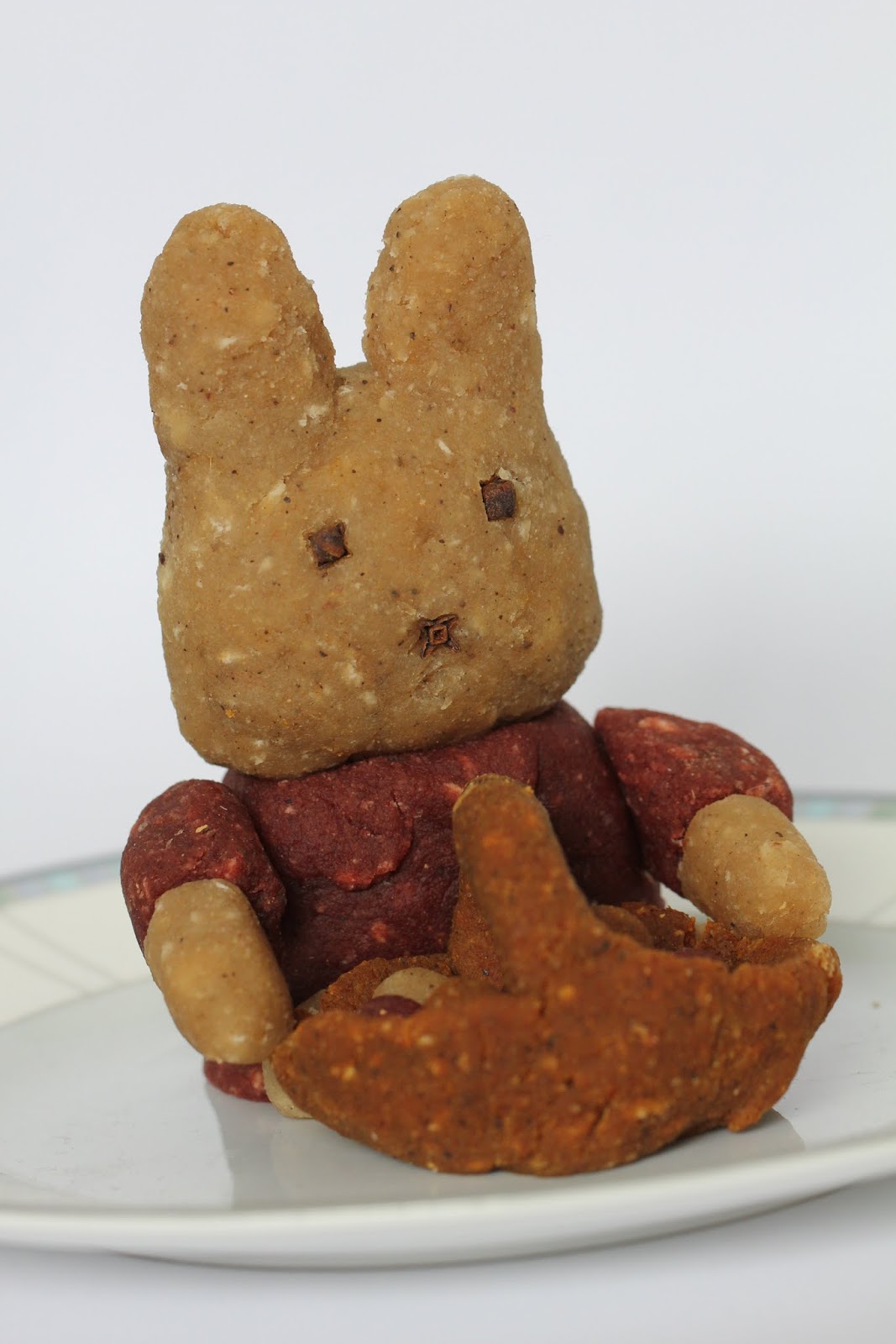
A gingerbread (i.e. breadcrumbs, honey and ginger) Miffy. Coloured with saffron and sandalwood.
Then it was time for the second tableload of food:
This consisted of the following:
Iussel (eggs scrambled in stock)
Mameny: chicken, almond milk, stock and rice flour. And saffron.
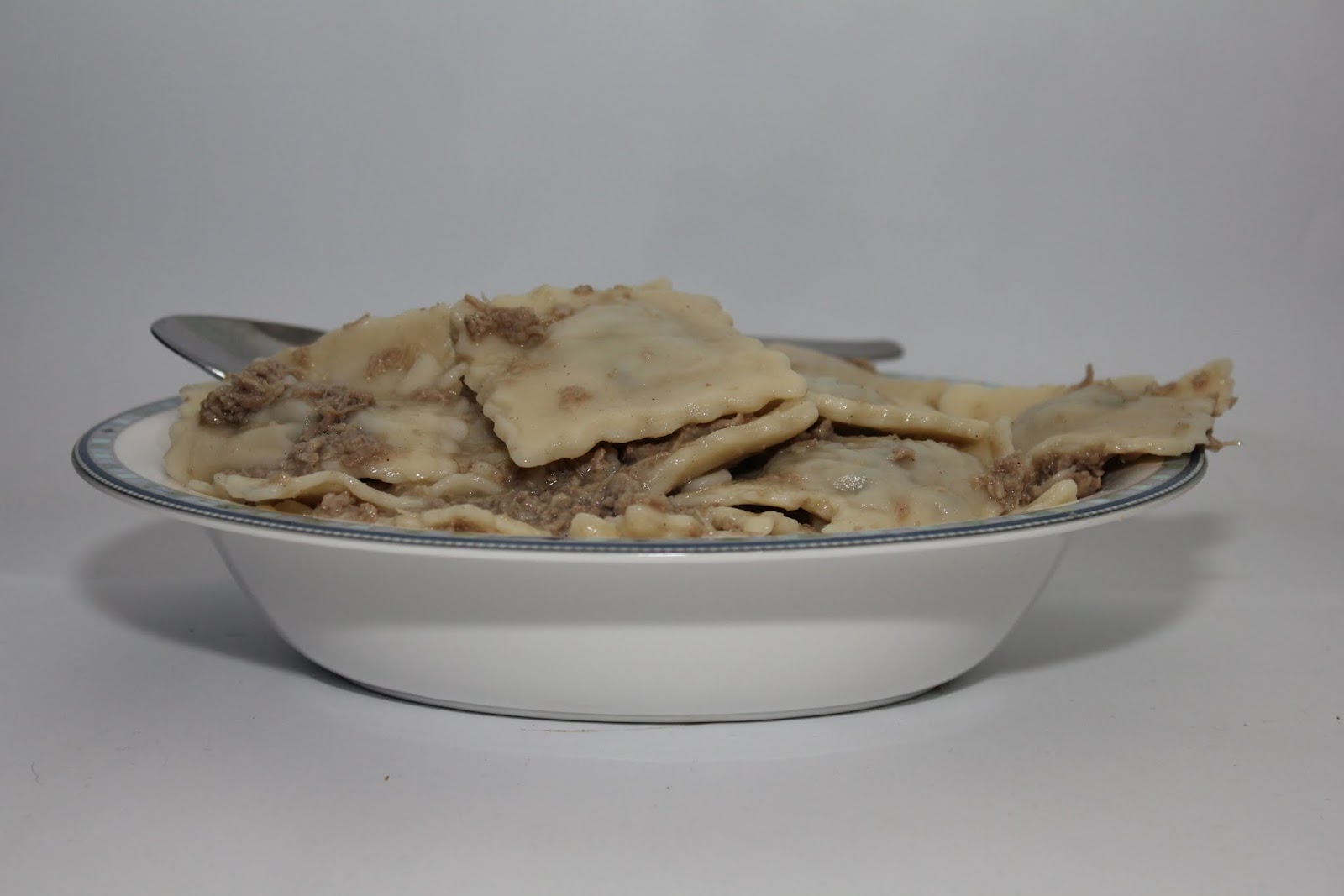
Tartlettes. Seriously, they had ravioli then. With a spiced pork-and-raisin filling.
Connynges in clere broth (aka "rabbit stoo")
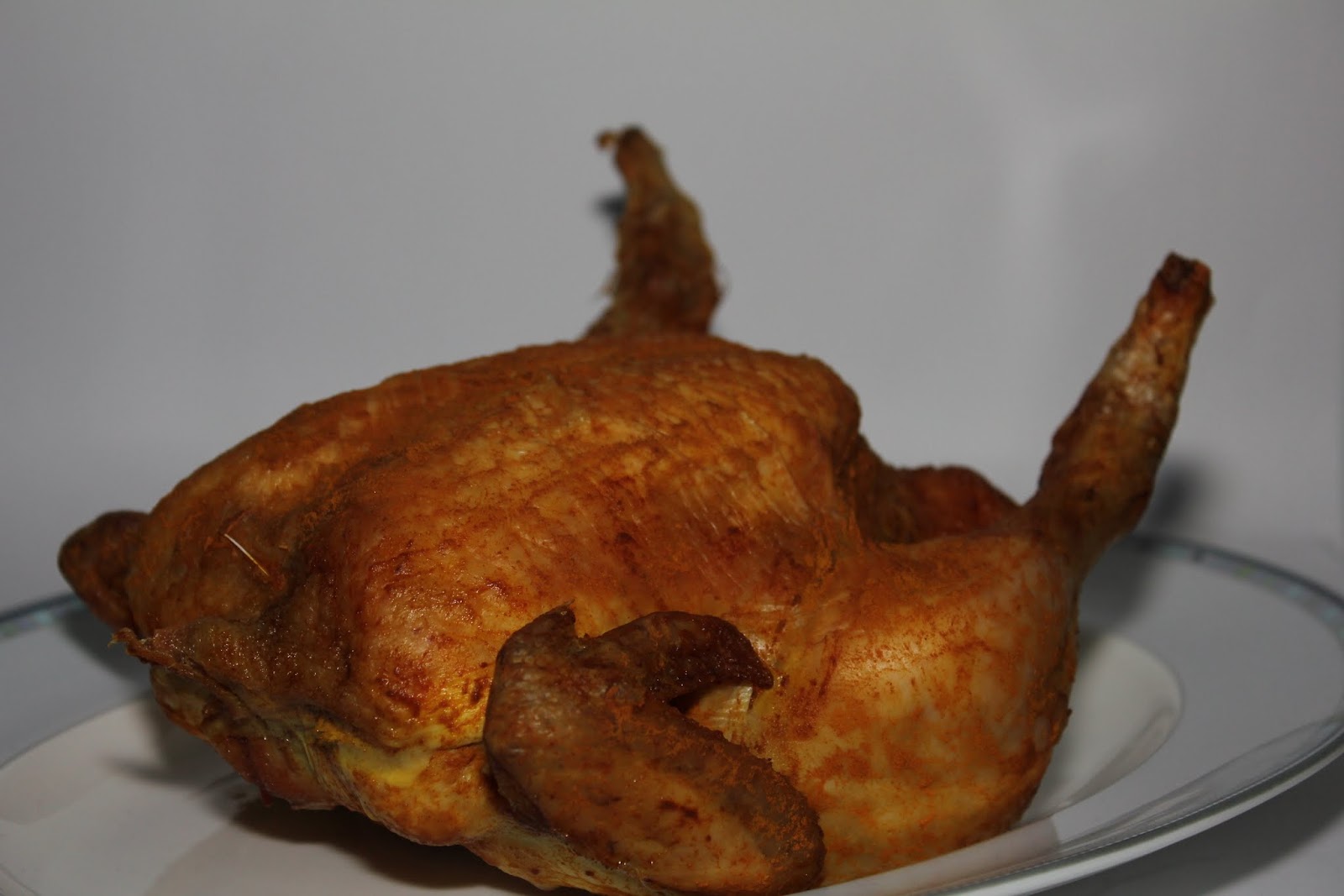
Capon endorre (golden roast chicken - the "gold" is saffron).
Vyuande cypre (pork and
chicken, minced with dates and spices)
Chyches (chickpeas in olive oil, garlic and spices)
Spynoches (spinach fried in lard with pepper)
The Mameny was a little bland, and the Vyuande cypre was insanely sweet, but the scrambled eggs were identified as an optimal hangover breakfast, and the ravioli was very modern (but if a recipe says "take minced pork and wrap it in thin leaves of dough and boil it", how else are you to interpret it?)
Once this was removed, it was time for the chef's next soteltie:
That's right, a sheep-shaped pie containing four-and-twenty fluffychicks. And sweeties.
We had a brief respite from eating whilst we played the traditional mediaeval game of "Who can eat a Haribo Tangfastic and then drink a cup of sweet mead?". The answer was "most people" - possibly the saffron was providing a protective coating to our tongues.
After whetting our appetites, it was time to move on to the serious eating:
Custard tart. OK, so it's called "Dariols", but the recipe for custard tart hasn't changed since 1390. It has saffron.
Crustardes (chicken, pigeon, pheasant and dried fruit pie)
Hasteletes (fig, dates, raisin and almond threaded on a skewer, in a saffron
batter, roasted)
Bursews: Pork-and-egg spiced meatballs. Battered. I can't remember if they contained saffron, but the odds are in favour that they did.
Rost of smal bryddes (quail, pigeon, and pousin, roasted)
Fryturs (battered apple fritters)
Having eaten this, and squabbled over the remaining hastelettes (oh, but they were good!), we retired to an adjacent room, admired the chef's next soteltie whilst eating confits and wafers and drinking pyment and hypocras, and felt a bit over-larded.
Sotel. Very Sotel.
Many thanks to Mrs S for the copy of her notes so I didn't have to work out how to spell the foodstuffs myself, and for all her sacrifices in the kitchen.